
Business gift tax rules UK employers need to know

A gift to an employee is tax-free when it costs £50 or less, isn’t cash or a cash voucher, and isn’t tied to performance or contract, thanks to HMRC’s trivial benefit exemption. Go above that threshold, pay in cash, or link the gift to a job well done, and it becomes a taxable benefit that belongs on a P11D or runs through payroll. Gifts to clients sit under different rules again: HMRC treats most of them as business entertainment, which means no deduction against your profits, with narrow exceptions for branded promotional items.
Before you order anything, ask three questions:
Is it cash, a cash voucher, or something that can be exchanged for cash?
Does the total cost per person stay at £50 or under?
Is there any hint of contractual obligation or reward for performance?
Get those three answers right and you’ll know within seconds whether you’re looking at a tax-free treat or a taxable benefit. Sayheygifting builds its employee boxes with exactly this threshold in mind, which is why so many HR teams turn to curated hampers rather than gambling with vouchers.
Key Takeaways
Whether a UK business gift is tax-free depends on three factors: its cost against the £50 trivial benefit threshold, whether it’s cash or a voucher, and whether it’s contractual.
Point | Details |
£50 threshold is absolute | Going even £1 over makes the entire gift taxable, not just the excess. |
Cash and vouchers never qualify | These count as earnings and go through payroll regardless of value. |
Client gifts default to non-deductible | Branding, samples, and the £50 annual cap are the main routes to relief. |
Reporting route matters | Choose payrolling, P11D, or a PSA before the tax year starts, not after. |
Record-keeping prevents disputes | Log recipient, cost, date, and business reason for every gift given. |
Table of Contents
Business gift tax rules for gifts to employees
The trivial benefits exemption is the single most useful tool in your gifting toolkit, and most employers underuse it. HMRC allows an unlimited number of trivial benefits across the tax year, provided each one satisfies four conditions: it costs £50 or less per person, it isn’t cash or a cash voucher, it isn’t a reward for work or performance, and it isn’t written into the employee’s contract. Miss any one of those and the whole gift becomes taxable, not just the excess above £50.
Where a gift fails the trivial benefit test, it becomes a benefit in kind. If you haven’t registered for payrolling benefits, you’ll need to report it on a P11D after the tax year ends, and Class 1A National Insurance falls due on the value. Employers, not employees, carry that NIC cost, so a £200 gift that fails the exemption isn’t just a tax headache for the recipient. It’s an unplanned NIC bill for the business.
Gift type | Typical cost | Likely HMRC treatment |
Small branded mug or diary | Under £50 | Tax-free trivial benefit |
Christmas hamper (non-contractual) | Up to £50 | Tax-free if under £50 and not tied to performance |
Over £50 | Over £50 | Taxable benefit, goes on P11D or payroll |
Cash or gift card | Any amount | Taxed as earnings through payroll |
Pro Tip: Label every gift in your accounting software and CRM with the recipient’s name, the date, the cost, and a one-line business reason (“staff appreciation, non-contractual”). That single habit is what separates a clean HMRC enquiry from a stressful one.
Sayheygifting’s trivial benefits guide walks through more edge cases if you’re building a year-round gifting calendar rather than a one-off.
How are gifts to clients and customers taxed?
Gifts to clients get far less generous treatment. HMRC’s Business Income Manual classes most business gifts as entertaining, which means they’re not an allowable deduction against your profits for corporation tax or income tax purposes. That surprises a lot of business owners who assume a bottle of wine sent to a client at Christmas is simply “cost of doing business.”
There are exceptions, and they’re worth building your gifting strategy around. A gift can remain deductible if it carries a conspicuous advertisement for your business, costs no more than £50 per recipient per year, and isn’t food, drink, tobacco, or a voucher exchangeable for those things. Genuine samples of your own product also escape the entertainment trap. BIM45000 sets out the exact boundary between a gift and entertainment, and it’s worth reading if you’re gifting at any scale.
VAT follows a similar pattern. VAT Notice 700/65 explains that input VAT on gifts to the same person can usually be reclaimed only if the total cost to that person across a 12-month period stays under £50, after which you must account for output tax as though you’d sold the item.
To improve your odds of relief:
Put your logo or company name clearly on the item itself.
Address gifts to the client organisation rather than a named individual where practical.
Keep the per-person, per-year cost under £50.
Avoid food, drink, and tobacco if deductibility matters to you.
Reporting and paying tax on taxable business gifts
Once a gift fails the trivial benefit test, it needs to go through one of three routes: a P11D submitted after the tax year, real-time payrolling of benefits, or a PAYE Settlement Agreement (PSA) that lets you settle the tax on the employees’ behalf. Employer Class 1A National Insurance applies regardless of which route you choose, calculated on the value of the benefit.
Decide before the tax year starts whether you’ll payroll benefits or use P11D. Payrolling needs registering with HMRC in advance and can’t be applied retrospectively for the current year.
If using P11D, submit by 6 July following the tax year end, and pay any Class 1A NIC by 22 July (or 19 July if paying by cheque).
For occasional or hard-to-value gifts across many employees, a PSA lets you make one annual payment covering tax and NIC, rather than reporting each gift individually.
Keep a running log throughout the year so nothing gets missed at year-end.
Before processing anything, your HR or accounts team should check:
Has each gift been tested against the trivial benefit conditions?
Is the payrolling registration in place, or does this need a P11D?
Are gift and entertainment costs recorded in separate ledger accounts?
Getting this wrong isn’t just a paperwork issue. Late or incorrect P11D filings attract penalties, and understated benefits can trigger interest alongside the tax due, so it pays to build the check into your existing payroll cycle rather than bolting it on afterwards.
What do common gift scenarios actually look like?
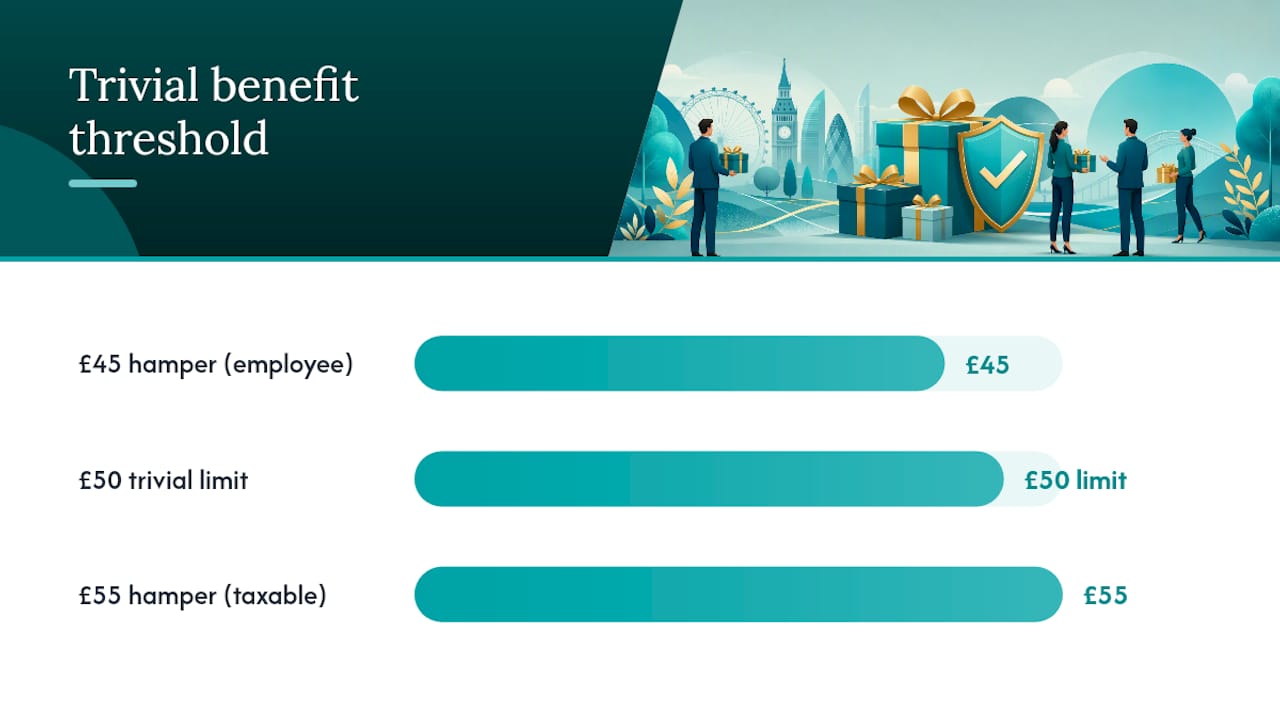
A branded mug or notebook sent to a supplier’s office, with your logo visible, usually clears the bar for both deductibility and VAT reclaim, because it’s promotional rather than a personal thank-you. A Christmas hamper posted to a named employee, costing £45 and given with no strings attached, almost always qualifies as a trivial benefit and stays off the payslip entirely.
Cash and gift cards behave differently no matter who receives them. HMRC treats these as near-cash, so they’re taxed as earnings through payroll, with no trivial benefit exemption available regardless of the amount.
Borderline case: a £55 hamper. Just £5 over the limit is enough to make the whole value taxable, not just the excess.
Borderline case: a “thank you for hitting target” gift under £50. The performance link disqualifies it even though the cost is fine.
Document every borderline decision with a short note explaining why you classed it as you did.
How to choose tax-efficient business gifts
Building a gifting habit that HMRC won’t query starts with procurement decisions for shopfitting supplies, not year-end paperwork. Set a cost ceiling per person, per occasion, ideally with headroom below £50 rather than pushing right up against it. Favour non-cash items: hampers, letterbox gifts, and branded merchandise all sit more comfortably within the exemption than any voucher, however “restricted” it claims to be.
Keep entertainment and gifting in separate ledger accounts from day one. Mixing them is one of the most common reasons small businesses struggle to justify claims when questioned, because it’s genuinely difficult to reconstruct intent months later. Where you’re gifting a corporate client, address the item to the business rather than an individual employee, since HMRC treats gifts made for business use by a company differently from personal gifts to a named person.
Pro Tip: Incidental extras like postage, gift wrapping, or a name engraving generally don’t add taxable value. Loading the box with a substantial non-promotional extra, on the other hand, risks tipping the whole gift into taxable territory.
Set a per-person cost ceiling with margin below £50.
Choose branded or promotional items over generic ones for clients.
Record recipient, cost, date, and purpose for every gift.
Keep packaging and postage costs modest and incidental.
Where to check the official rules
Expenses and benefits: gifts to employees covers the trivial benefit conditions in full.
BIM45065 explains why client gifts count as entertainment.
Income tax: trivial benefits in kind guidance gives worked examples of qualifying items.
VAT Notice 700/65 sets out VAT reclaim conditions on client gifts.
Choosing gifts that keep HR teams and accountants on the same page
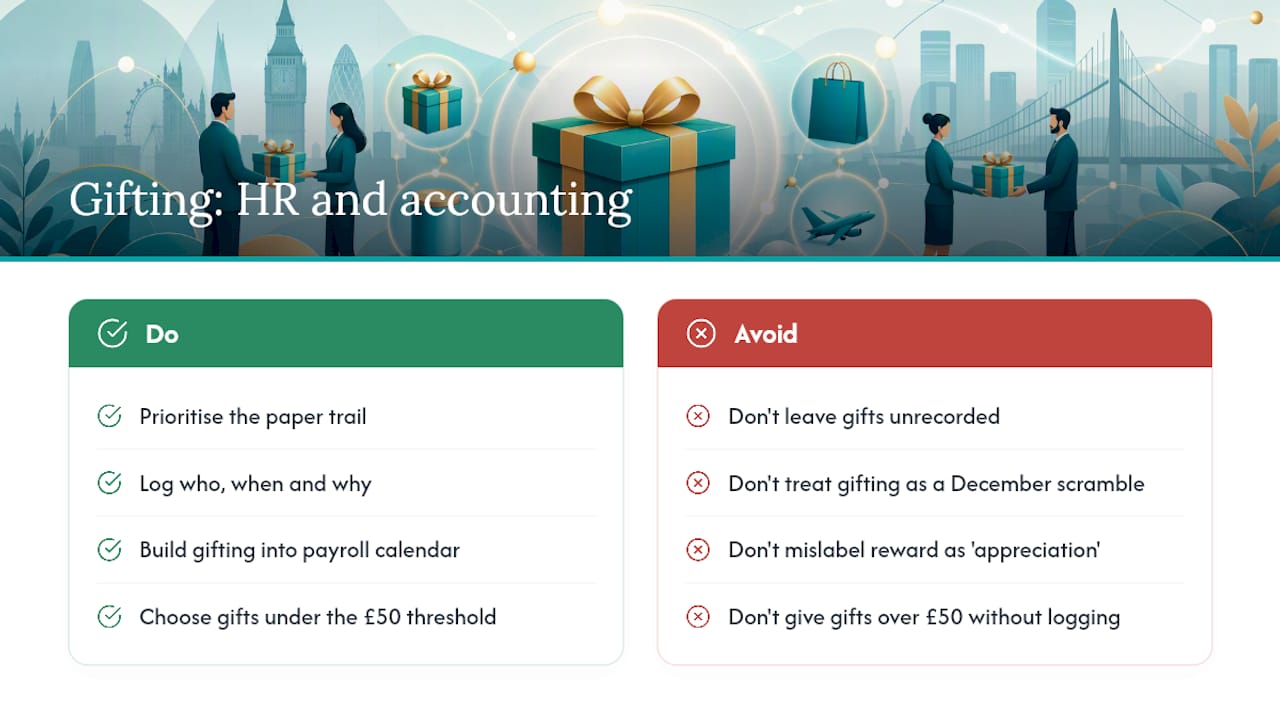
The conventional advice on business gift tax stops at explaining the £50 threshold and leaves employers to work out the practical side themselves. That’s backwards. The rule itself is simple; the failure point is almost always administrative, not legal. Businesses don’t usually lose trivial benefit relief because they misunderstand HMRC’s definition. They lose it because nobody logged the gift, or because a well-meaning manager slipped a £60 hamper to their top performer and called it appreciation rather than reward.
If you take one thing from this, prioritise the paper trail before the gift itself. A £45 hamper with no record of who received it, when, or why is a weaker position than the same hamper logged properly in a spreadsheet. HR teams that build gifting into their existing payroll calendar, rather than treating it as a December scramble, consistently avoid the P11D surprises that catch smaller employers out every January. Choose gifts under the threshold as a default setting, not an exception you remember only at Christmas.
This article is general information, not a substitute for advice from a qualified financial advisor. Consult a qualified financial professional about your own circumstances before acting on anything here.
Sources
FAQ
What are the tax rules for business gift tax?
Employee gifts under £50 that aren’t cash, vouchers, or performance-linked are tax-free trivial benefits; gifts to clients are usually treated as non-deductible entertainment unless they’re branded promotional items under £50 a year.
How much money can be gifted tax-free in the UK for staff?
Up to £50 per person per occasion, with no annual cap on the number of qualifying trivial benefits an employer can give, provided each one meets the conditions separately.
How much can a business gift a client and still get relief?
Generally up to £50 per recipient per year, and only if the item carries a clear advertisement for the business and isn’t food, drink, tobacco, or a voucher for those things.
Do I need to declare gifted money to HMRC?
Cash gifts to employees are taxed as earnings and must go through payroll; non-cash gifts that exceed the trivial benefit conditions need reporting via P11D, payrolling, or a PAYE Settlement Agreement.
If you’re planning your next round of staff or client gifting, Sayheygifting’s employee gift boxes and letterbox gifts priced well below the £50 threshold are built with the £50 threshold in mind, so you can appreciate your team without creating extra work for payroll.
Recommended
Comments