
VAT on corporate gifts: the £50 rule UK businesses need

VAT becomes payable on a corporate gift when two things happen together: you reclaimed the input VAT when you bought it, and the total cost to that same recipient goes over £50 (excluding VAT) within any rolling 12 months. Miss either condition and the gift stays outside output VAT entirely. Get it wrong, and HMRC can assess the full value of every gift given to that person in the period, not just the amount over the threshold.
Before you order another hamper or branded mug, three checks will save you a headache later:
Confirm whether input VAT was actually reclaimed on the purchase invoice.
Add up everything given to that same person over the past 12 months, not just this single gift.
Keep the supplier invoice and a record of who received what, and when.
The detail sits in VAT Notice 700/7, HMRC’s guidance on business promotions, and in the supporting VAT manual. The sections below walk through the £50 test, the accounting entries, and where employee gifts diverge from client gifts, with worked figures throughout.
Key Takeaways
VAT on corporate gifts is due only when input VAT was reclaimed and the recipient’s cumulative gifts exceed £50 excluding VAT within any rolling 12-month period.
Point | Details |
Check the reclaim first | Confirm whether input VAT was actually reclaimed on the gift before assuming any liability exists. |
Track by recipient, not by order | Run a rolling 12-month total per person, since small gifts add up unnoticed across the year. |
Keep VAT and PAYE separate | Trivial benefit rules for employees and the £50 VAT test are two distinct checks, not one. |
Document the business reason | A brief note on each gift’s purpose helps resist HMRC reclassification as payment for services. |
Choose invoicing that supports tracking | Sayheygifting provides clear VAT invoices and recipient-referenced paperwork on corporate orders to simplify the 12-month test. |
Table of Contents
What counts as a business gift for VAT purposes?
A business gift, for VAT purposes, is goods you give away free of charge in the course of promoting your business, where you were entitled to reclaim the VAT on buying them. That entitlement is the trigger. If there was never any input VAT to reclaim, there is nothing to account for later, regardless of the item’s value.
This covers a broader range of everyday gifting than most finance teams assume. A hamper sent to a long-standing client, a branded tote handed out at a trade show, and product samples posted to a prospective buyer all sit inside the definition. HMRC’s supply and consideration guidance in VATSC03321 sets out when a free transfer of goods counts as a supply for VAT purposes and when it does not.
Some things fall outside the business gift rules entirely:
Cash, and anything treated as equivalent to cash, is never a “gift” in this VAT sense.
Gifts to a business owner or a connected person for personal, non-business reasons don’t qualify, because there’s no promotional purpose behind them.
Services provided free of charge generally don’t create the same VAT liability, since no goods change hands.
Non-cash vouchers can qualify, but the voucher rules bring their own complications, covered later in this guide.
The common thread is the business reason test. The transfer has to serve a genuine commercial purpose, whether that’s client retention, brand awareness, or encouraging a prospect to place an order. A birthday present bought for the managing director’s spouse doesn’t clear that bar, however nice it might be.
Two quick scenarios show the distinction in practice. A finance director buys a hamper for a key client, reclaims the input VAT on the purchase invoice, and sends it as a thank you for a renewed contract. That’s a textbook business gift. Compare that with a sample pack of new product lines posted to a prospect who has never bought from you. Both are gifts under the VAT rules, but the second is far more likely to be treated as a genuine sample, which can carry its own exemption, covered in the special cases section below.
Pro Tip: Keep a one-line note on the invoice or in your accounting software explaining the business reason for each gift. It costs seconds now and can be the difference between a quick HMRC query and a drawn-out enquiry.
How does the £50 rule work for corporate gifts?
The rule itself is simple to state: if the total cost of gifts to the same person is £50 or less, excluding VAT, in any 12-month period, no output VAT is due. Go a penny over that figure across the period and VAT becomes due on the full cost of every gift given to that person during it, not merely the excess.

Two features of the rule trip people up more than any other. First, it’s a rolling 12-month test, not a calendar year or a tax year. You need to look back 12 months from the date of each new gift to see whether the cumulative total has tipped over £50. Second, the £50 figure is always calculated excluding VAT, even though the VAT was the very thing you reclaimed on the purchase.
Take a client who receives a bottle of wine in March and a gift box in October. Individually, neither item looks like a problem. Added together within the same 12-month window, the total cost pushes the recipient over the threshold and triggers output VAT on the full amount, according to the HMRC manual reference VATVAL11240.
Compare that with an employee who receives a single hamper at Christmas and nothing else that year. That stays under the £50 limit, so no output VAT arises on the VAT side, though the trivial benefit rules for PAYE still need checking separately, which the next section covers in full.
A simple aggregation table makes the rolling test far easier to manage than trying to hold it in your head:
Once that cumulative column crosses £50, output VAT is due on the whole £55, not the £5 overspill.
Pro Tip: Run a simple spreadsheet or accounting tag by recipient name rather than by order date. Sorting gifts by order date hides the pattern; sorting by recipient reveals it instantly.

When do you have to account for output VAT?
The mechanics come down to one question: did you reclaim input VAT on the purchase? If you did, and the £50 threshold is breached, you must account for output VAT on the full cost of the gifts to that recipient. If you never reclaimed the input VAT in the first place, there’s no output VAT to account for, whatever the gift cost, because you never benefited from the tax relief that the rule exists to claw back.
VAT Notice 700/7 is explicit on this point: reclaiming input tax on a gift you later give away is what creates the liability. A business that decides never to reclaim input VAT on gifts avoids the tracking exercise entirely, at the cost of losing that input tax relief on every item, however small.
Here’s a worked example with numbers. The business reclaims the £12 input VAT. That client had already received £10 worth of gifts earlier in the year, so the cumulative total is now £70, which is above £50.
The bookkeeping itself is straightforward once you’ve decided to reclaim. On purchase, debit the gifts expense account for £60, debit input VAT for £12, and credit the supplier or bank for £72. When the cumulative total breaches £50, post a separate output VAT charge: debit a gifts expense or cost-of-sales adjustment for £14, and credit output VAT payable for the same amount. That output VAT then goes on your VAT return in the normal way.
Before reclaiming input VAT on any gift, run through this short checklist:
Who is the recipient, and are they an employee, a client, or a prospect?
Is there a genuine business reason for the gift?
What has this recipient already received in the last 12 months?
Will this gift push their cumulative total over £50 excluding VAT?
If yes, is it worth reclaiming the input VAT at all, given the output VAT liability it creates?
That last question matters more than it looks. THP Chartered Accountants points out that once you reclaim input VAT and breach the threshold, you owe output VAT on the full cost, not just the increment. For small, regular gifts to the same people, some finance teams find it simpler to skip the input VAT reclaim altogether rather than track every recipient’s rolling total.
Pro Tip: Tag every gift purchase in your accounting software with the recipient’s name, not just a general “marketing” or “staff welfare” code. A quarterly report filtered by recipient will flag anyone approaching £50 before you place the next order.
Do employee gifts follow the same VAT rules as client gifts?
No, and conflating the two is one of the most common errors finance teams make. VAT and PAYE/National Insurance are two entirely separate regimes, and a gift can pass one test while failing the other.
For employees, the relevant PAYE relief is the trivial benefit exemption. GOV.UK guidance sets out the conditions clearly: the gift must cost £50 or less, must not be cash or a cash voucher, must not be a reward for work performance, and must not be something the employee is contractually entitled to. Meet all four conditions and the gift is exempt from tax and National Insurance, with no need to report it on a P11D. Directors of close companies face an annual cap of £300 across all trivial benefits, which is worth flagging if you’re a small owner-managed business.
Fail any one of those conditions, and the gift becomes a taxable benefit, reportable through payroll, a P11D, or a PAYE Settlement Agreement, with Class 1A National Insurance due from the employer. That’s an entirely separate cost from any VAT question.
Here’s how the two regimes line up side by side:
VAT reclaim: governed by whether the item was a genuine business gift and whether the £50 (ex VAT) 12-month threshold has been breached.
PAYE reporting: governed by the trivial benefit conditions, independent of the VAT treatment.
Class 1A NI: due only if the trivial benefit conditions fail and the gift becomes a taxable benefit.
P11D or PSA reporting: required only where the gift doesn’t meet the trivial benefit exemption.
A worked example shows how these can pull in different directions. A staff Christmas hamper costs £70. That’s above the £50 trivial benefit limit, so PAYE and Class 1A NI now apply to the full value, and it needs reporting via a P11D or PSA. Separately, if input VAT was reclaimed on that £70 hamper and the employee received nothing else gift-related that year, the £50 VAT threshold is also breached, triggering output VAT on the £70. Two different tax consequences, from the same purchase, assessed under two different sets of rules. ACCA’s guidance on Christmas gifts walks through several similar combinations.
HMRC’s own manual also flags a subtler point worth knowing: perks targeted at specific individuals, rather than offered inclusively across a workforce, are more likely to attract a private-use output tax charge under VIT43700. An inclusive gifting policy, where every member of a team receives the same treatment, tends to sit more comfortably with HMRC than a pattern of gifts singled out for particular employees. Many finance teams settle on a simple house rule: keep every staff gift under £50 and avoid reclaiming input VAT on anything that might push a client over the same line. It’s a blunt instrument, but it removes most of the tracking burden. For a fuller breakdown of how the trivial benefit exemption interacts with payroll, see this guide to trivial benefits rules for UK employers.
What special VAT rules apply to samples, vouchers and charity gifts?
Several categories of gift sit outside the standard £50 test, and treating them as ordinary business gifts is a common source of confusion.
Samples supplied for genuine business purposes, such as letting a prospect try a product before committing to an order, can fall outside the £50 rule altogether under certain conditions set out in HMRC’s guidance. The key test is whether the item is genuinely a sample used to promote a sale, rather than a finished product given away as a thank you. The line isn’t always obvious, so keep a note of the promotional intent behind any item you classify this way.
Gifts to charities can attract zero-rating in specific circumstances, provided the donation meets HMRC’s stated conditions around genuine charitable purpose and correct documentation. This is a narrower relief than many businesses assume, so check the specific goods and the charity’s own status before assuming zero-rating applies automatically.
Vouchers and gift cards carry their own layer of rules. HMRC distinguishes between single-purpose vouchers, where the VAT liability is fixed and known at the point of issue, and multi-purpose vouchers, where VAT is only accounted for when the voucher is actually redeemed. GOV.UK’s guidance on voucher VAT treatment sets out exactly when the tax point falls for each type. Cash vouchers, meanwhile, sit outside VAT scope but are still taxed as earnings if handed to an employee, so the PAYE trivial benefit exemption never applies to them.
International recipients add a further wrinkle. Goods genuinely exported to a recipient outside the UK are generally outside the scope of UK VAT, because export supplies are treated differently from domestic ones. That doesn’t mean the gift is free of tax considerations altogether. Customs duties, import VAT in the destination country, and local record-keeping requirements can still apply, so a branded gift box posted to an overseas prospect needs a different compliance check from one delivered to a client in Leeds.
A short comparison makes the distinction concrete: branded pens sent to a prospect in Germany fall outside UK output VAT because the goods have left the UK, but the recipient’s own country may apply import VAT or customs charges on arrival. The same pens sent to a UK client are assessed entirely under the domestic £50 rule described earlier in this guide.
What are the most common VAT mistakes on corporate gifts?
Most VAT problems on corporate gifts come from a handful of repeated errors, and nearly all of them are avoidable with better record-keeping.
Failing to aggregate gifts by recipient, so a series of small purchases quietly breaches £50 without anyone noticing.
Reclaiming input VAT at purchase and then forgetting to account for output VAT once the threshold is crossed later in the year.
Treating goods sent to social media influencers as simple gifts, when HMRC increasingly views them as payment in kind for promotional services.
Misclassifying a multi-purpose voucher as a straightforward gift and getting the VAT tax point wrong as a result.
Weak record-keeping that leaves no trail of who received what, and when, making the 12-month test impossible to verify later.
HMRC has specific red flags it watches for. Repeated, large-value shipments to a single recipient stand out immediately in an audit. Influencer arrangements, in particular, have drawn scrutiny, with HaysMac reporting that HMRC has actively reclassified goods sent to influencers as consideration for marketing services rather than genuine gifts, which changes the VAT treatment entirely. Inconsistent ledger coding, where similar purchases are booked under different account codes from one month to the next, also makes an enquiry harder to close quickly, simply because nothing lines up cleanly.
If HMRC does raise a query, a calm, structured response saves considerably more time than a scramble through old emails:
Gather every invoice for gifts given in the period under review.
Compile a single ledger showing each recipient, the date, the item, and the cost excluding VAT.
Check your reclaim history against that ledger to confirm which purchases had input VAT reclaimed.
Seek professional advice promptly if the numbers don’t reconcile cleanly, rather than guessing an answer.
Documenting the business purpose behind each gift at the time it’s given is the single most useful habit here. It’s far easier for HMRC to argue that a pattern of “gifts” to one contact was really payment for promotional work when there’s no paper trail showing a genuine, unconditional business reason behind each one. For a broader look at operational slip-ups beyond VAT, this rundown of common corporate gifting mistakes is worth a read.
A practical VAT compliance checklist for ordering corporate gifts
Before placing an order, whether it’s one hamper or two hundred, running through a short checklist prevents most VAT problems before they start:
Confirm the recipient’s identity and category, client, prospect, or employee.
Confirm there’s a genuine business reason for the gift and note it briefly.
Record the cost excluding VAT at the point of purchase, not the VAT-inclusive figure.
Decide deliberately whether to reclaim the input VAT, weighing the admin cost against the relief.
Update your recipient’s rolling 12-month cumulative total immediately, not at year-end.
Retain the supplier’s VAT invoice alongside a note of who the gift went to.
An internal tracking sheet with the following columns handles most of this without needing specialist software:
| Recipient name | Type | Date | Description | Cost excl. VAT | VAT reclaimed (Y/N) | 12-month cumulative | Notes |

Keeping this updated in real time, rather than reconstructing it from memory at year-end, is what actually makes the £50 rule manageable. When ordering from a supplier, ask for a clear, itemised VAT invoice and, where possible, include the recipient’s name or a reference code on the paperwork itself. That single habit turns a messy audit trail into a five-minute lookup. Running a quarterly report from your accounting software, filtered by recipient, will also flag anyone drifting close to the £50 mark well before the next order goes out. For the practical side of getting gifts to the right people on time, this corporate gift delivery guide covers the logistics that sit alongside good VAT record-keeping.
Why the £50 rule catches out well-run finance teams
The businesses that get caught out by this rule are rarely careless. They’re usually well-organised finance teams who track VAT carefully at the transaction level but miss the recipient-level pattern that builds up over a year. A £15 gift here, a £30 gift there, each one perfectly reasonable on its own, and nobody notices the running total until an HMRC review pulls the whole year’s gifting together in one spreadsheet.
The conventional advice, keep gifts under £50, is true but incomplete. It treats the rule as a per-item ceiling when it’s actually a per-person, rolling annual ceiling. That distinction is precisely what a transaction-by-transaction accounting system is bad at catching, because most ledgers are built to track spend by category or supplier, not by the person on the receiving end of a gift.
There’s also a tendency to assume PAYE compliance and VAT compliance are the same exercise, because both happen to reference £50. They’re not. A hamper can clear the trivial benefit test for an employee and still trigger output VAT if the recipient’s cumulative gifts for the year tip past £50, or vice versa. Treating them as one check, rather than two separate ones, is where a surprising number of otherwise careful businesses come unstuck.
The businesses that manage this well tend to build recipient-level tracking into ordering from day one, rather than trying to reconstruct it retrospectively. That’s less about accounting sophistication and more about habit. Sayheygifting works with finance and HR teams who value that discipline, supplying clear VAT invoicing on every corporate order and recipient-referenced paperwork that slots straight into an internal 12-month tracker.
How Sayheygifting keeps corporate gifting VAT-friendly
Getting the gift right shouldn’t mean wrestling with a spreadsheet afterwards. Sayheygifting supplies clear, itemised VAT invoices on every order, whether that’s a single employee gift box or a bulk hamper run for an entire office, so your finance team has exactly what it needs to run the 12-month recipient test without chasing paperwork.
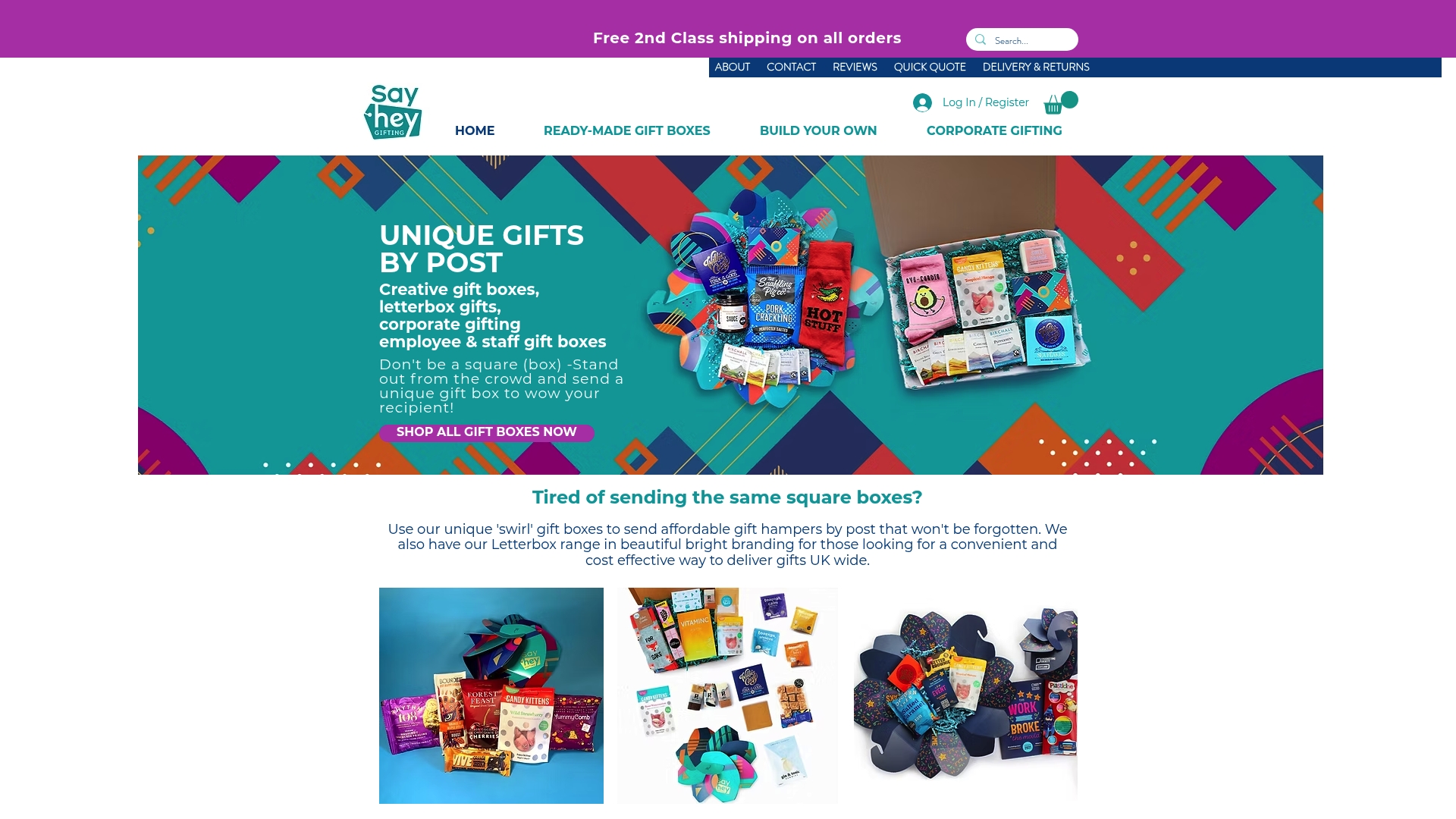
Ordering through Sayheygifting means every purchase comes with recipient labelling and custom packing slips that make it simple to log who received what, and when, straight into your internal tracker. If a client’s cumulative total is close to £50, you can also request items priced to sit comfortably under the threshold, whether that’s a letterbox gift under £10 or a build your own gift box where you control the value per recipient directly. For staff-wide rounds, the employee gift box range is built for exactly this kind of inclusive, easy-to-track gifting.
None of this is a substitute for tax advice. Complex or borderline cases should always go to HMRC directly or to your accountant. If you want a straightforward starting point, request a quote and ask for VAT-clear invoicing on your order, and take it from there.
Sources
For anything beyond the general principles covered here, go straight to the primary guidance rather than relying on secondary summaries:
For binding interpretations on unusual or high-value cases, HMRC’s own helplines and a qualified accountant remain the safest route. This guide explains how the rules generally apply, but it isn’t a substitute for professional advice on your specific circumstances.
This article is general information, not a substitute for advice from a qualified financial advisor. Consult a qualified financial professional about your own circumstances before acting on anything here.
FAQ
Is VAT always due on corporate gifts?
No. VAT is due only if you reclaimed input VAT on the gift and the recipient’s cumulative gifts exceed £50 excluding VAT within a rolling 12-month period.
Does the £50 limit include VAT?
No, the £50 threshold is always calculated excluding VAT, even though the VAT itself is what triggers the liability if the limit is breached.
Can I reclaim VAT on gifts to employees?
Yes, but if the cumulative value to that employee exceeds £50 excluding VAT in 12 months, you’ll need to account for output VAT, separately from any PAYE or National Insurance due under the trivial benefit rules.
What happens if I don’t reclaim input VAT on a gift?
If you never reclaim the input VAT, there’s no output VAT liability on that gift, regardless of its value, because the rule exists to reverse relief you actually claimed.
Do gifts sent overseas attract UK VAT?
Generally no, because exported goods fall outside UK VAT scope, though the recipient’s own country may apply import VAT or customs duties on arrival.
Can Sayheygifting provide VAT invoices for corporate orders?
Yes, Sayheygifting supplies clear VAT invoicing and recipient-referenced paperwork on corporate gift orders to help finance teams track the 12-month threshold accurately.
Recommended
Comments