
Business gift VAT UK rules: when the £50 limit applies

If a business gift costs £50 or less (excluding VAT) per person in any rolling 12-month period, it is not treated as a supply for VAT purposes, so you do not need to account for output VAT on it. HMRC sets this out in VAT Notice 700/7 and confirms the value limit in VATSC03322. The gift must genuinely serve a business purpose, and different rules apply to samples, staff entertainment, and anything carrying conspicuous advertising, so it pays to check which category yours falls into before assuming you are covered.
TL;DR:
Gifts given to clients or business contacts that stay within a £50 cost limit (excluding VAT) in a rolling 12-month period are not subject to output VAT, provided they serve a genuine business purpose.
Businesses must track all gifts to each recipient over 12 months, including costs like delivery and personalization, to avoid exceeding the threshold unintentionally.
Once the total gifts to a person surpass £50 within 12 months, output VAT becomes due on the full value of all gifts to that individual during that period, not just the excess.
Reclaiming input VAT is permitted only if the gift is bought solely for business purposes and the recipient’s cumulative spend is under the threshold; otherwise, VAT must be reported as output.
Exceptions such as promotional samples, staff gifts, and items with conspicuous advertising have separate rules and do not always count towards the £50 limit or VAT treatment.
Table of Contents
What counts as a business gift for VAT and how the £50 limit works
HMRC defines a business gift as goods given away voluntarily, with no payment or obligation attached, where the giving is connected to your business. That last part matters: a hamper sent to a long-standing client to say thank you for their custom usually qualifies. A leaving present bought for your own staff member with no business promotional purpose does not sit in the same category, and often falls under different rules entirely, which we cover further down.
The £50 figure is calculated on your cost as the donor, excluding VAT, not the retail price the recipient might associate with the item. If you buy a branded gift box wholesale for £42 plus VAT, that £42 is the figure that counts towards the limit, even if it would sell for £70 in a shop. Delivery charges, personalisation costs, and any other direct costs you incur getting that gift to the recipient are added into the total.
The rule works on a rolling 12-month basis, not a calendar or tax year. This is the detail businesses trip over most often. If you send a client a £30 gift in March and another £25 gift to the same person the following January, you have exceeded £50 within a 12-month window even though the two gifts fell either side of a new tax year. HMRC’s own guidance confirms this rolling structure applies per recipient, not per transaction.
A quick way to classify a gift before you commit budget to it includes checking whether the recipient benefits personally without reciprocal business expectations, totaling all gifts given to the person in the trailing 12 months, using the actual cost excluding VAT rather than retail value, ensuring the item serves a business purpose like client goodwill or brand visibility, and confirming it is distinct from samples, staff rewards, or entertainment, each treated differently by HMRC.
Low-value promotional items such as branded pens, diaries, or a small letterbox treat almost always sit comfortably under £50 on their own. Problems tend to arise with premium hampers, festive gift sets, or anything bundled with wine, where a single item can quietly consume most or all of the annual allowance for that recipient in one go.

How to reclaim input VAT and when output VAT becomes due
Getting the VAT treatment right comes down to a simple sequence, but skipping a step is where most finance teams get caught out. Work through it in order every time a gift purchase is processed.
Confirm the business purpose and reclaim input VAT at purchase. If the gift is bought wholly for business purposes, you can normally reclaim the input VAT on the purchase in the same way as any other business expense, provided you hold a valid VAT invoice.
Check the recipient’s running total. Before finalising the purchase, look back over the previous 12 months and add up everything already given to that specific person. Spreadsheets and CRM tags both work here; consistency matters more than the tool.
Compare the new running total against £50. If the cumulative cost (excluding VAT) stays at or under £50, no output VAT is due. Nothing further needs to happen on that gift for VAT purposes.
If the total exceeds £50 and input VAT was reclaimed, account for output VAT on the full cost. This is the step businesses most often miss. You do not just pay VAT on the portion above £50; HMRC treats the entire value of gifts to that person in the period as a taxable supply once the threshold is breached, and output VAT becomes due on the total, not the excess.
Report the output VAT on your VAT return in the same way you would for any other deemed supply, using the value of the goods as the taxable amount.
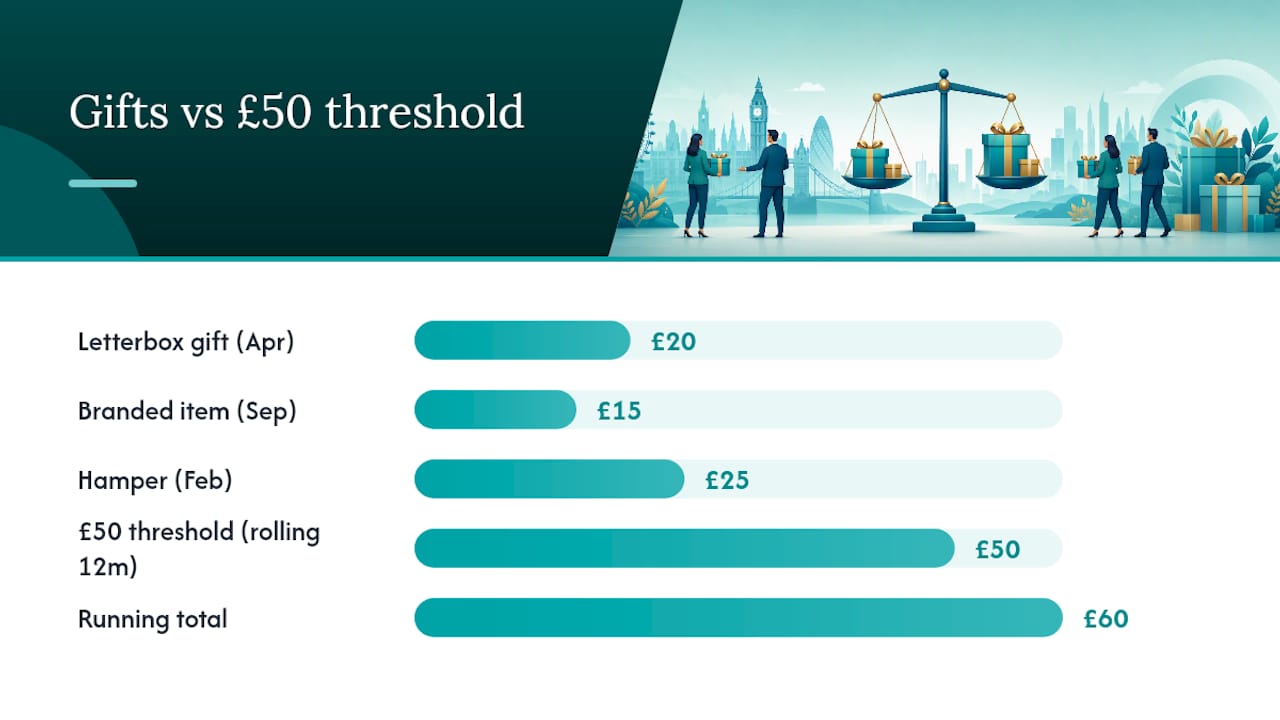
Here is how that plays out with real figures. Say your business sends a client three gifts across a 12-month window: a £20 letterbox gift in April, a £15 branded item in September, and a £25 hamper the following February. The running total after the third gift is £60, exceeding the £50 threshold. If input VAT was reclaimed on all three purchases, output VAT is now due on the full £60, not just the £10 over the limit.
Statistic callout: The threshold itself, £50 excluding VAT per person per rolling year, has not moved for a long time, which is exactly why finance teams assume it is a fixed, easy-to-forget number rather than something to track actively month by month, according to HMRC’s guidance on discounts and gifts.
One point worth flagging clearly: you cannot issue a VAT invoice to the recipient for a gift, because there is no consideration changing hands. VATSC03325 confirms this, and it creates a genuinely awkward commercial trap. If your business ends up owing output VAT on a gift because the £50 limit was breached, that VAT cost sits entirely with you as the donor. The recipient has no invoice to reclaim against, even if they are VAT-registered themselves. There is no mechanism to pass that cost on or recover it elsewhere; it is simply an expense your business absorbs.
Exceptions: samples, staff gifts, charities, and advertising
Not every item you give away follows the £50 business gift rule, and treating everything the same way is where compliance starts to unravel. Several categories carry their own logic entirely.
Free samples are treated differently from gifts. Genuine samples, given to promote a product and provided in a form that lets the recipient assess the product rather than simply consume it as a finished item, can fall outside VAT entirely, per VATVAL11240. The key distinction is promotional intent versus a straightforward giveaway.
Gifts to your own staff usually fall under the trivial benefits exemption for tax purposes rather than the business gift VAT rule, provided the benefit costs £50 or less, is not cash or a cash voucher, and is not a reward for performance or written into a contract. This is a separate regime from VAT business gifts, and the two get confused constantly.
Conspicuous advertising is an exception that applies mainly to corporation tax deductibility rather than VAT itself. BIM45070 sets out that a gift carrying a clear advertisement for the business, on the item itself rather than just the packaging, can qualify as a deductible business expense even outside the usual small-gifts allowance. Food, drink, tobacco, and vouchers for goods are specifically excluded from this test.
Charitable donations of goods can sometimes be zero-rated where the recipient is a charity and specific conditions are met, which is a different route entirely from the £50 business gift allowance.
Pro Tip: If you want a gift to qualify for the conspicuous advertising exception on the corporation tax side, the branding needs to be printed on the product itself, not just the outer box. A logo on the ribbon or wrapping does not count; it has to travel with the item after unwrapping.
Gifts tied to events, such as a hamper sent to a speaker after a conference appearance, often get miscategorised as promotional gifts when HMRC would actually view them as entertainment, given the contractual or reciprocal element involved. That distinction changes both the VAT and the corporation tax treatment, so it is worth checking the context of why a gift is being given, not just its price tag.
Tracking the £50 limit: records that hold up to scrutiny
Good record-keeping is the difference between a defensible VAT position and a stressful HMRC query. The system does not need to be complicated, but it does need to capture the right fields consistently, every time.
Record the recipient’s identity clearly, using a name rather than just a company, since the £50 limit applies per person, not per organisation.
Note the cost excluding VAT, taken directly from the purchase invoice, alongside the invoice reference number for audit purposes.
Log the date of the gift so it can be matched against the rolling 12-month window for that individual.
Add a one-line business reason, such as “client thank-you” or “referral introduction”, which supports the business-purpose test if ever questioned.
Apportion multi-component gifts correctly. If a single hamper is split between two recipients, the cost needs dividing between them on a fair basis, rather than counted once against a single person’s running total.
A simple spreadsheet with recipient name, date, cost, and running total works perfectly well for smaller volumes. Businesses gifting at scale often tag gift purchases within their CRM against the client record instead, which keeps the 12-month lookback automatic rather than manual. Whichever system you choose, the practical habit that saves the most time is checking the rolling total before you buy, not after. Our guide to VAT on corporate gifts walks through a template businesses use to keep this simple month to month.
Common pitfalls: where businesses get the VAT treatment wrong
The single biggest error is failing to total gifts to the same recipient across the full 12 months. Businesses frequently check each gift purchase in isolation, see it is under £50, and move on, without realising three separate small gifts to one client have quietly pushed the annual total over the line.
Treating a contractual “thank you” gift, promised as part of a deal or introduction fee, as a simple promotional gift when it is arguably consideration for services, which changes the VAT position entirely.
Confusing VAT recovery with corporation tax deductibility. These are separate regimes: you can reclaim input VAT on a gift purchase while a completely different set of rules, including the conspicuous advertising test, governs whether that same spend reduces your corporation tax bill.
Charging output VAT on a gift that breaches £50, then assuming the recipient can recover that cost themselves. As covered earlier, no VAT invoice can be issued for a no-consideration supply, so the cost sits with your business permanently.
Assuming a “gift” bought at trade cost with a healthy margin built in doesn’t need revaluing; HMRC looks at your actual cost, not the margin you would have made on a sale.
Pro Tip: Keep VAT and corporation tax questions separate in your head when reviewing a gift. Ask “is this under £50 to this person in 12 months?” for VAT, and “does this carry conspicuous advertising or a genuine business purpose?” for corporation tax. They are different tests with different answers.
If a gift sits close to entertainment territory, such as one linked to hospitality or an event, it is worth reading how entertainment sourcing typically gets categorised before assuming standard gift rules apply.
Applying these rules when you actually choose gifts for clients and staff
Most of the VAT guidance around business gifts reads as though every gift purchase happens in isolation, one hamper, one invoice, one calculation. In practice, the businesses that get this right are the ones who build the £50 tracking into how they buy, not something they reconcile afterwards under pressure before a VAT return deadline.
The gap I keep seeing is between the rule as written and the rule as lived. HMRC’s £50 threshold sounds simple until you are running a Christmas gifting round for 200 clients, some of whom also received a smaller thank-you gift in June that nobody flagged. The compliance risk rarely comes from bad faith. It comes from decentralised buying, where marketing, sales, and HR each send gifts to overlapping contact lists with no shared record.
At Sayheygifting, invoices are itemised clearly by cost excluding VAT, which makes the record-keeping side genuinely straightforward rather than something you reconstruct from a card statement later. Packaging on branded items is also designed with the conspicuous advertising test in mind, since logo placement on the product itself, not just the box, is what determines whether a gift can support a corporation tax claim as well as sitting safely under the VAT threshold.
The businesses that stay compliant without stress are usually the ones with one person, or one system, owning the recipient list.
— Craig
Buy gifts under £50 that are built to be VAT-friendly
Sayheygifting gives you an easier way to stay under the £50 threshold than trying to bundle a generic hamper and hope the arithmetic works out. Every product category, from letterbox gifts to full employee gift boxes, is configurable, so you set the price point deliberately rather than discovering it after checkout.
The employee gift box range and the build your own gift box tool both let you control exact contents and cost per recipient, which makes the £50 calculation something you decide upfront rather than check retrospectively. For lighter-touch gifting, the letterbox gift range sits comfortably under the threshold on its own, useful when you are already close to a recipient’s annual limit. Every order comes with itemised invoicing showing cost excluding VAT, so the record you need for HMRC is already sitting in your inbox rather than something your finance team has to chase down later. If you are planning gifting for staff or clients this year, start by checking your build under the employee gift box page or configure a custom option and get a quote before you commit to volume.
Primary sources and key references
The VAT treatment of business gifts rests on a small number of HMRC publications, and it is worth reading the primary guidance directly rather than relying solely on secondary summaries, since HMRC does periodically update internal manual entries.
The core rule sits in VAT Notice 700/7 on business promotions, which covers the £50 threshold, the rolling 12-month period, and how promotional schemes more broadly interact with VAT. VATSC03322 and VATVAL11240 provide the internal manual detail behind the value limit and the samples distinction respectively. For the corporation tax side, particularly the conspicuous advertising exception, BIM45070 is the relevant manual entry. HMRC updates guidance periodically, so it is worth checking GOV.UK directly before relying on figures for a large gifting programme.
FAQ
Is VAT due on a business gift under £50?
No. If the total cost to you as the donor, excluding VAT, stays at or under £50 per person within any rolling 12-month period, HMRC does not treat it as a taxable supply, so no output VAT is due.
Do I need to declare gifted goods to HMRC?
There is no separate declaration required for compliant business gifts under £50; you simply need records showing the cost and recipient in case HMRC asks. If the £50 limit is breached, you account for output VAT on your normal VAT return rather than a separate disclosure.
Can a business gift more than £50 to one client per year?
Yes, but once the cumulative cost to that person exceeds £50 excluding VAT within 12 months, output VAT becomes due on the entire value of gifts given to them in that period, not just the amount over the limit.
What is the difference between a business gift and a free sample for VAT?
A free sample is provided specifically to let a customer evaluate a product and typically falls outside the £50 gift rule entirely under VATVAL11240, whereas a standard business gift is judged against the £50 threshold.
Can I reclaim VAT on gifts to staff?
Staff gifts are usually assessed under the trivial benefits exemption rather than the business gift VAT rule, provided the gift costs £50 or less, is not cash, and is not tied to performance or a contractual entitlement.
Recommended
Comments